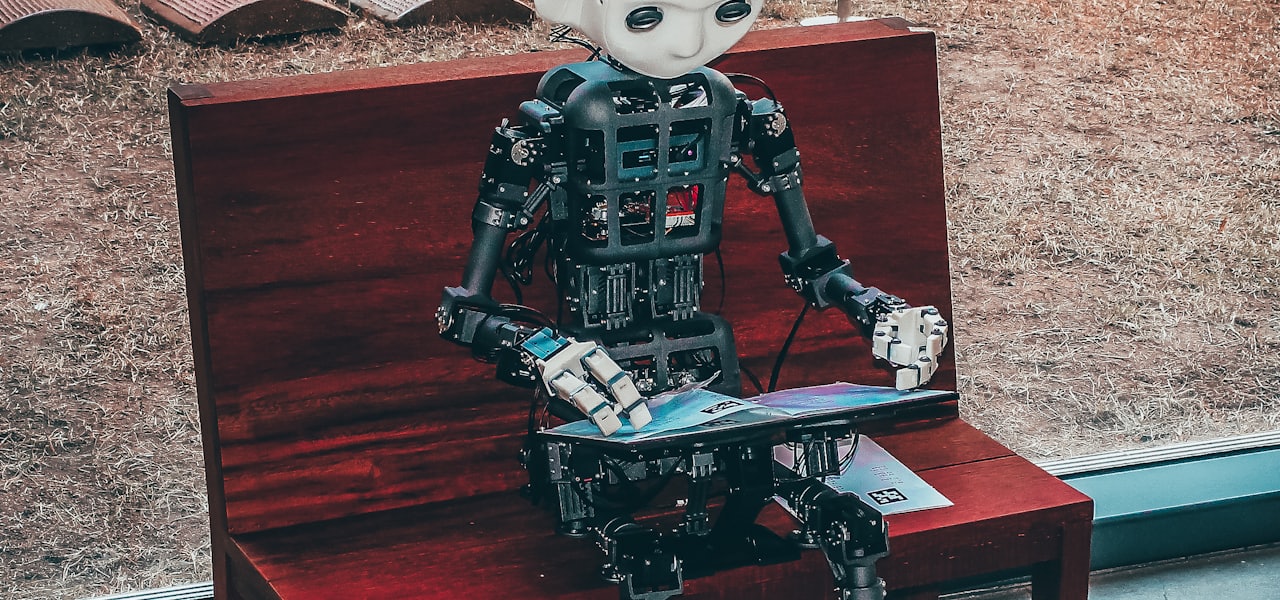
"The Last Question" is a science fiction short story by American writer Isaac Asimov. It first appeared in the November 1956 issue of Science Fiction Quarterly; and in the anthologies in the collections Nine Tomorrows (1959), The Best of Isaac Asimov (1973), Robot Dreams (1986), The Best Science Fiction of Isaac Asimov (1986), the retrospective Opus 100 (1969), and Isaac Asimov: The Complete Stories, Vol. 1 (1990). While he also considered it one of his best works, "The Last Question" was Asimov's favorite short story of his own authorship, and is one of a loosely connected series of stories concerning a fictional computer called Multivac. Through successive generations, humanity questions Multivac on the subject of entropy. The story blends science fiction, theology, and philosophy. It has been recognized as a counterpoint to Fredric Brown's short short story "Answer", published two years earlier. == History == In conceiving Multivac, Asimov was extrapolating the trend towards centralization that characterized computation technology planning in the 1950s to an ultimate centrally managed global computer. After seeing a planetarium adaptation of his work, Asimov "privately" concluded that the story was his best science fiction yet written. He placed it just higher than "The Ugly Little Boy" (September 1958) and "The Bicentennial Man" (1976). The story asks the question of humanity's fate, and human existence as a whole, highlighting Asimov's focus on important aspects of our future like population growth and environmental issues. "The Last Question" ranks with "Nightfall" (1941) as one of Asimov's best-known and most acclaimed short stories. He wrote in 1973 that he appreciated how easy the story was to write after he had the idea. He was so often approached by fans who remembered the story but not the title, that in one instance he gave the answer, correctly, before the fan had even described the story. == Plot summary == By the year 2061, Multivac, a self-adjusting and self-correcting computer, has allowed mankind to reach beyond the planetary confines of Earth and harness solar energy. Two technicians, Adell and Lupov, celebrate Multivac's role in this development. Over drinks, they discuss that the sun will expire due to the second law of thermodynamics, which states that entropy inevitably increases. When Adell asks Multivac whether this can be reversed, the computer responds that it has insufficient data to answer. In several episodes over ten trillion years, increasingly advanced humans pose the same question to the computers of their time. Each time the computer gives the same response. At the heat death of the universe, the last disembodied consciousness of Man asks the question a final time of a computer that resides in hyperspace before merging with it. After collecting the last data from the dead universe, the computer continues to process it alone and finds an answer to the last question. Having no one to tell it to, it proceeds to demonstrate by saying "LET THERE BE LIGHT!" == Themes == === Philosophy === Although science and religion are frequently presented as having an oppositional relationship, "The Last Question" explores some biblical contexts ("Let there be light"). In Asimov's story, aspects like the great meaning of existence are culminated through both technology and human knowledge. The evolution from Multivac to AC also emulates a sort of cycle of existence. === Dystopian happy ending === Multivac's purpose was conceptualized with a desire for knowledge, promoting the idea that more knowledge will lead to a better and more fruitful future for humanity. However, the computer's answers regarding the future suggest an inevitable exhaustion of the Sun, and this thirst for knowledge becomes an obsession with the future. The story's end displays a dichotomy between annihilation and peace. == Dramatic adaptations == === Planetarium shows === "The Last Question" was first adapted for the Abrams Planetarium at Michigan State University (in 1966), featuring the voice of Leonard Nimoy, as Asimov wrote in his autobiography In Joy Still Felt (1980). It was adapted for the Strasenburgh Planetarium in Rochester, New York (in 1969), under the direction of Ian C. McLennan. It was adapted for the Edmonton Space Sciences Centre in Edmonton, Alberta (early 1970s), under the direction of John Hault. It was adapted for the Gates Planetarium at the Denver Museum of Natural History in 1973 under the direction of Mark B. Peterson It subsequently played at the: Fels Planetarium of the Franklin Institute in Philadelphia in 1973 Planetarium of the Reading School District in Reading, Pennsylvania in 1974 Buhl Planetarium, Pittsburgh in 1974 The Space Transit Planetarium of the Museum of Science in Miami during 1977 Vanderbilt Planetarium in Centerport New York, in 1978, read by singer-songwriter and Long Island resident Harry Chapin. Hansen Planetarium in Salt Lake City, Utah (in 1980 and 1989) A reading of the story was played on BBC Radio 7 in 2008 and 2009. Gates Planetarium in Denver, Colorado (in early 2020) In 1989 Asimov updated the star show adaptation to add in quasars and black holes. The story was adapted as a comic book by Don Thompson and drawn by John Estes in the third issue of ORBiT.
Drops (app)
Drops is a language learning app that was created in Estonia by Daniel Farkas and Mark Szulyovszky in 2015. It is the second product from the company, after their first app, LearnInvisible, had issues in retaining a user's engagement over the required time period. The languages available include Native Hawaiian and Māori, and was classified as one of the fifty "Most Innovative Companies" for 2019 by Fast Company. The company partnered with Global Eagle Entertainment to include Travel Talk, a feature intended to focus on words and phrases frequently used by travelers. At the beginning of the COVID-19 pandemic in March 2020, the number of users increased by 55 percent in the United States and 92 percent in the United Kingdom. Droplets, a language app for children, includes profiles for multiple teachers working with remote students. The company also produces an app called Scripts, intended to help users learn to write alphabets. The app was purchased by the Norwegian company Kahoot! on 24 November 2020.
International Conference on Computer Vision
The International Conference on Computer Vision (ICCV) is a research conference sponsored by the Institute of Electrical and Electronics Engineers (IEEE) held every other year. It is considered to be one of the top conferences in computer vision, alongside CVPR and ECCV, and it is held on years in which ECCV is not. The conference is usually spread over four to five days. Typically, experts in the focus areas give tutorial talks on the first day, then the technical sessions (and poster sessions in parallel) follow. Recent conferences have also had an increasing number of focused workshops and a commercial exhibition. == Awards == === Azriel Rosenfeld Lifetime Achievement Award === The Azriel Rosenfeld Award, or Azriel Rosenfeld Lifetime Achievement Award, recognizes researchers who have made significant contributions to the field of computer vision over their careers. It is named in memory of computer scientist and mathematician Azriel Rosenfeld. The following people have received this award: === Helmholtz Prize === The ICCV Helmholtz Prize, known as the Test of Time Award before 2013, is awarded every other year at the ICCV, recognizing ICCV papers from ten or more years earlier that had a significant impact on computer vision research. Winners are selected by the IEEE Computer Society's Technical Committee on Pattern Analysis and Machine Intelligence. The award is named after the 19th century physician and physicist Hermann von Helmholtz, and the ICCV's award is not related to the various Helmholtz Prizes in physics, or the Hermann von Helmholtz Prize in neuroscience. === Marr Prize === The ICCV best-paper award is the Marr Prize, named after British neuroscientist David Marr. === Mark Everingham Prize === The Mark Everingham Prize is an award given yearly by the Technical Committee on Pattern Analysis and Machine Intelligence of the IEEE Computer Society at the IEEE International Conference on Computer Vision or the European Conference on Computer Vision to commemorate the late Mark Everingham, "one of the rising stars of computer vision", and to encourage others to follow in his footsteps by acting to further progress in the computer vision community as a whole. The prize is given to a researcher, or a team of researchers, who have made a selfless contribution of significant benefit to other members of the computer vision community. The Mark Everingham Prize for Rigorous Evaluation was an award given in 2012 at the British Machine Vision Conference. === PAMI Distinguished Researcher Award === The PAMI Distinguished Researcher Award (until 2013 called Significant Researcher Award) is awarded to candidates whose research projects have significantly contributed to the progress of computer vision. Awards are made based on major research contributions, as well as the role of those contributions in influencing and inspiring other research. Candidates are nominated by the community. The following people have received this award: == Conference list == The conference is usually held in the Spring in various international locations.
Count sketch
Count sketch is a type of dimensionality reduction that is particularly efficient in statistics, machine learning and algorithms. It was invented by Moses Charikar, Kevin Chen and Martin Farach-Colton in an effort to speed up the AMS Sketch by Alon, Matias and Szegedy for approximating the frequency moments of streams (these calculations require counting of the number of occurrences for the distinct elements of the stream). The sketch is nearly identical to the Feature hashing algorithm by John Moody, but differs in its use of hash functions with low dependence, which makes it more practical. In order to still have a high probability of success, the median trick is used to aggregate multiple count sketches, rather than the mean. These properties allow use for explicit kernel methods, bilinear pooling in neural networks and is a cornerstone in many numerical linear algebra algorithms. == Intuitive explanation == The inventors of this data structure offer the following iterative explanation of its operation: at the simplest level, the output of a single hash function s mapping stream elements q into {+1, -1} is feeding a single up/down counter C. After a single pass over the data, the frequency n ( q ) {\displaystyle n(q)} of a stream element q can be approximated, although extremely poorly, by the expected value E [ C ⋅ s ( q ) ] {\displaystyle {\mathbf {E}}[C\cdot s(q)]} ; a straightforward way to improve the variance of the previous estimate is to use an array of different hash functions s i {\displaystyle s_{i}} , each connected to its own counter C i {\displaystyle C_{i}} . For each i, the E [ C i ⋅ s i ( q ) ] = n ( q ) {\displaystyle {\mathbf {E}}[C_{i}\cdot s_{i}(q)]=n(q)} still holds, so averaging across the i range will tighten the approximation; the previous construct still has a major deficiency: if a lower-frequency-but-still-important output element a exhibits a hash collision with a high-frequency element even for one of the s i {\displaystyle s_{i}} hashes, n ( a ) {\displaystyle n(a)} estimate can be significantly affected. Avoiding this requires reducing the frequency of collision counter updates between any two distinct elements. This is achieved by replacing each C i {\displaystyle C_{i}} in the previous construct with an array of m counters (making the counter set into a two-dimensional matrix C i , j {\displaystyle C_{i,j}} ), with index j of a particular counter to be incremented/decremented selected via another set of hash functions h i {\displaystyle h_{i}} that map element q into the range {1..m}. Since E [ C i , h i ( q ) ⋅ s i ( q ) ] = n ( q ) {\displaystyle {\mathbf {E}}[C_{i,h_{i}(q)}\cdot s_{i}(q)]=n(q)} , averaging across all values of i will work. == Mathematical definition == 1. For constants w {\displaystyle w} and t {\displaystyle t} (to be defined later) independently choose d = 2 t + 1 {\displaystyle d=2t+1} random hash functions h 1 , … , h d {\displaystyle h_{1},\dots ,h_{d}} and s 1 , … , s d {\displaystyle s_{1},\dots ,s_{d}} such that h i : [ n ] → [ w ] {\displaystyle h_{i}:[n]\to [w]} and s i : [ n ] → { ± 1 } {\displaystyle s_{i}:[n]\to \{\pm 1\}} . It is necessary that the hash families from which h i {\displaystyle h_{i}} and s i {\displaystyle s_{i}} are chosen be pairwise independent. 2. For each item q i {\displaystyle q_{i}} in the stream, add s j ( q i ) {\displaystyle s_{j}(q_{i})} to the h j ( q i ) {\displaystyle h_{j}(q_{i})} th bucket of the j {\displaystyle j} th hash. At the end of this process, one has w d {\displaystyle wd} sums ( C i j ) {\displaystyle (C_{ij})} where C i , j = ∑ h i ( k ) = j s i ( k ) . {\displaystyle C_{i,j}=\sum _{h_{i}(k)=j}s_{i}(k).} To estimate the count of q {\displaystyle q} s one computes the following value: r q = median i = 1 d s i ( q ) ⋅ C i , h i ( q ) . {\displaystyle r_{q}={\text{median}}_{i=1}^{d}\,s_{i}(q)\cdot C_{i,h_{i}(q)}.} The values s i ( q ) ⋅ C i , h i ( q ) {\displaystyle s_{i}(q)\cdot C_{i,h_{i}(q)}} are unbiased estimates of how many times q {\displaystyle q} has appeared in the stream. The estimate r q {\displaystyle r_{q}} has variance O ( m i n { m 1 2 / w 2 , m 2 2 / w } ) {\displaystyle O(\mathrm {min} \{m_{1}^{2}/w^{2},m_{2}^{2}/w\})} , where m 1 {\displaystyle m_{1}} is the length of the stream and m 2 2 {\displaystyle m_{2}^{2}} is ∑ q ( ∑ i [ q i = q ] ) 2 {\displaystyle \sum _{q}(\sum _{i}[q_{i}=q])^{2}} . Furthermore, r q {\displaystyle r_{q}} is guaranteed to never be more than 2 m 2 / w {\displaystyle 2m_{2}/{\sqrt {w}}} off from the true value, with probability 1 − e − O ( t ) {\displaystyle 1-e^{-O(t)}} . === Vector formulation === Alternatively Count-Sketch can be seen as a linear mapping with a non-linear reconstruction function. Let M ( i ∈ [ d ] ) ∈ { − 1 , 0 , 1 } w × n {\displaystyle M^{(i\in [d])}\in \{-1,0,1\}^{w\times n}} , be a collection of d = 2 t + 1 {\displaystyle d=2t+1} matrices, defined by M h i ( j ) , j ( i ) = s i ( j ) {\displaystyle M_{h_{i}(j),j}^{(i)}=s_{i}(j)} for j ∈ [ w ] {\displaystyle j\in [w]} and 0 everywhere else. Then a vector v ∈ R n {\displaystyle v\in \mathbb {R} ^{n}} is sketched by C ( i ) = M ( i ) v ∈ R w {\displaystyle C^{(i)}=M^{(i)}v\in \mathbb {R} ^{w}} . To reconstruct v {\displaystyle v} we take v j ∗ = median i C j ( i ) s i ( j ) {\displaystyle v_{j}^{}={\text{median}}_{i}C_{j}^{(i)}s_{i}(j)} . This gives the same guarantees as stated above, if we take m 1 = ‖ v ‖ 1 {\displaystyle m_{1}=\|v\|_{1}} and m 2 = ‖ v ‖ 2 {\displaystyle m_{2}=\|v\|_{2}} . == Relation to Tensor sketch == The count sketch projection of the outer product of two vectors is equivalent to the convolution of two component count sketches. The count sketch computes a vector convolution C ( 1 ) x ∗ C ( 2 ) x T {\displaystyle C^{(1)}x\ast C^{(2)}x^{T}} , where C ( 1 ) {\displaystyle C^{(1)}} and C ( 2 ) {\displaystyle C^{(2)}} are independent count sketch matrices. Pham and Pagh show that this equals C ( x ⊗ x T ) {\displaystyle C(x\otimes x^{T})} – a count sketch C {\displaystyle C} of the outer product of vectors, where ⊗ {\displaystyle \otimes } denotes Kronecker product. The fast Fourier transform can be used to do fast convolution of count sketches. By using the face-splitting product such structures can be computed much faster than normal matrices.
Correspondence analysis
Correspondence analysis (CA) is a multivariate statistical technique proposed by Herman Otto Hartley (Hirschfeld) and later developed by Jean-Paul Benzécri. It is conceptually similar to principal component analysis, but applies to categorical rather than continuous data. In a manner similar to principal component analysis, it provides a means of displaying or summarising a set of data in two-dimensional graphical form. Its aim is to display in a biplot any structure hidden in the multivariate setting of the data table. As such it is a technique from the field of multivariate ordination. Since the variant of CA described here can be applied either with a focus on the rows or on the columns it should in fact be called simple (symmetric) correspondence analysis. It is traditionally applied to the contingency table of a pair of nominal variables where each cell contains either a count or a zero value. If more than two categorical variables are to be summarized, a variant called multiple correspondence analysis should be chosen instead. CA may also be applied to binary data given the presence/absence coding represents simplified count data i.e. a 1 describes a positive count and 0 stands for a count of zero. Depending on the scores used CA preserves the chi-square distance between either the rows or the columns of the table. Because CA is a descriptive technique, it can be applied to tables regardless of a significant chi-squared test. Although the χ 2 {\displaystyle \chi ^{2}} statistic used in inferential statistics and the chi-square distance are computationally related they should not be confused since the latter works as a multivariate statistical distance measure in CA while the χ 2 {\displaystyle \chi ^{2}} statistic is in fact a scalar not a metric. == Details == Like principal components analysis, correspondence analysis creates orthogonal components (or axes) and, for each item in a table i.e. for each row, a set of scores (sometimes called factor scores, see Factor analysis). Correspondence analysis is performed on the data table, conceived as matrix C of size m × n where m is the number of rows and n is the number of columns. In the following mathematical description of the method capital letters in italics refer to a matrix while letters in italics refer to vectors. Understanding the following computations requires knowledge of matrix algebra. === Preprocessing === Before proceeding to the central computational step of the algorithm, the values in matrix C have to be transformed. First compute a set of weights for the columns and the rows (sometimes called masses), where row and column weights are given by the row and column vectors, respectively: w m = 1 n C C 1 , w n = 1 n C 1 T C . {\displaystyle w_{m}={\frac {1}{n_{C}}}C\mathbf {1} ,\quad w_{n}={\frac {1}{n_{C}}}\mathbf {1} ^{T}C.} Here n C = ∑ i = 1 n ∑ j = 1 m C i j {\displaystyle n_{C}=\sum _{i=1}^{n}\sum _{j=1}^{m}C_{ij}} is the sum of all cell values in matrix C, or short the sum of C, and 1 {\displaystyle \mathbf {1} } is a column vector of ones with the appropriate dimension. Put in simple words, w m {\displaystyle w_{m}} is just a vector whose elements are the row sums of C divided by the sum of C, and w n {\displaystyle w_{n}} is a vector whose elements are the column sums of C divided by the sum of C. The weights are transformed into diagonal matrices W m = diag ( 1 / w m ) {\displaystyle W_{m}=\operatorname {diag} (1/{\sqrt {w_{m}}})} and W n = diag ( 1 / w n ) {\displaystyle W_{n}=\operatorname {diag} (1/{\sqrt {w_{n}}})} where the diagonal elements of W n {\displaystyle W_{n}} are 1 / w n {\displaystyle 1/{\sqrt {w_{n}}}} and those of W m {\displaystyle W_{m}} are 1 / w m {\displaystyle 1/{\sqrt {w_{m}}}} respectively i.e. the vector elements are the inverses of the square roots of the masses. The off-diagonal elements are all 0. Next, compute matrix P {\displaystyle P} by dividing C {\displaystyle C} by its sum P = 1 n C C . {\displaystyle P={\frac {1}{n_{C}}}C.} In simple words, Matrix P {\displaystyle P} is just the data matrix (contingency table or binary table) transformed into portions i.e. each cell value is just the cell portion of the sum of the whole table. Finally, compute matrix S {\displaystyle S} , sometimes called the matrix of standardized residuals, by matrix multiplication as S = W m ( P − w m w n ) W n {\displaystyle S=W_{m}(P-w_{m}w_{n})W_{n}} Note, the vectors w m {\displaystyle w_{m}} and w n {\displaystyle w_{n}} are combined in an outer product resulting in a matrix of the same dimensions as P {\displaystyle P} . In words the formula reads: matrix outer ( w m , w n ) {\displaystyle \operatorname {outer} (w_{m},w_{n})} is subtracted from matrix P {\displaystyle P} and the resulting matrix is scaled (weighted) by the diagonal matrices W m {\displaystyle W_{m}} and W n {\displaystyle W_{n}} . Multiplying the resulting matrix by the diagonal matrices is equivalent to multiply the i-th row (or column) of it by the i-th element of the diagonal of W m {\displaystyle W_{m}} or W n {\displaystyle W_{n}} , respectively. === Interpretation of preprocessing === The vectors w m {\displaystyle w_{m}} and w n {\displaystyle w_{n}} are the row and column masses or the marginal probabilities for the rows and columns, respectively. Subtracting matrix outer ( w m , w n ) {\displaystyle \operatorname {outer} (w_{m},w_{n})} from matrix P {\displaystyle P} is the matrix algebra version of double centering the data. Multiplying this difference by the diagonal weighting matrices results in a matrix containing weighted deviations from the origin of a vector space. This origin is defined by matrix outer ( w m , w n ) {\displaystyle \operatorname {outer} (w_{m},w_{n})} . In fact matrix outer ( w m , w n ) {\displaystyle \operatorname {outer} (w_{m},w_{n})} is identical with the matrix of expected frequencies in the chi-squared test. Therefore S {\displaystyle S} is computationally related to the independence model used in that test. But since CA is not an inferential method the term independence model is inappropriate here. === Orthogonal components === The table S {\displaystyle S} is then decomposed by a singular value decomposition as S = U Σ V ∗ {\displaystyle S=U\Sigma V^{}\,} where U {\displaystyle U} and V {\displaystyle V} are the left and right singular vectors of S {\displaystyle S} and Σ {\displaystyle \Sigma } is a square diagonal matrix with the singular values σ i {\displaystyle \sigma _{i}} of S {\displaystyle S} on the diagonal. Σ {\displaystyle \Sigma } is of dimension p ≤ ( min ( m , n ) − 1 ) {\displaystyle p\leq (\min(m,n)-1)} hence U {\displaystyle U} is of dimension m×p and V {\displaystyle V} is of n×p. As orthonormal vectors U {\displaystyle U} and V {\displaystyle V} fulfill U ∗ U = V ∗ V = I {\displaystyle U^{}U=V^{}V=I} . In other words, the multivariate information that is contained in C {\displaystyle C} as well as in S {\displaystyle S} is now distributed across two (coordinate) matrices U {\displaystyle U} and V {\displaystyle V} and a diagonal (scaling) matrix Σ {\displaystyle \Sigma } . The vector space defined by them has as number of dimensions p, that is the smaller of the two values, number of rows and number of columns, minus 1. === Inertia === While a principal component analysis may be said to decompose the (co)variance, and hence its measure of success is the amount of (co-)variance covered by the first few PCA axes - measured in eigenvalue -, a CA works with a weighted (co-)variance which is called inertia. The sum of the squared singular values is the total inertia I {\displaystyle \mathrm {I} } of the data table, computed as I = ∑ i = 1 p σ i 2 . {\displaystyle \mathrm {I} =\sum _{i=1}^{p}\sigma _{i}^{2}.} The total inertia I {\displaystyle \mathrm {I} } of the data table can also computed directly from S {\displaystyle S} as I = ∑ i = 1 n ∑ j = 1 m s i j 2 . {\displaystyle \mathrm {I} =\sum _{i=1}^{n}\sum _{j=1}^{m}s_{ij}^{2}.} The amount of inertia covered by the i-th set of singular vectors is ι i {\displaystyle \iota _{i}} , the principal inertia. The higher the portion of inertia covered by the first few singular vectors i.e. the larger the sum of the principal inertiae in comparison to the total inertia, the more successful a CA is. Therefore, all principal inertia values are expressed as portion ϵ i {\displaystyle \epsilon _{i}} of the total inertia ϵ i = σ i 2 / ∑ i = 1 p σ i 2 {\displaystyle \epsilon _{i}=\sigma _{i}^{2}/\sum _{i=1}^{p}\sigma _{i}^{2}} and are presented in the form of a scree plot. In fact a scree plot is just a bar plot of all principal inertia portions ϵ i {\displaystyle \epsilon _{i}} . === Coordinates === To transform the singular vectors to coordinates which preserve the chi-square distances between rows or columns an additional weighting step is necessary. The resulting coordinates are called principal coordinates in CA text books. If principal coordinates are used for
Healthy Together
Healthy Together is a health technology company that provides software for Health & Humans Services Departments. Healthy Together supports a “One Door” approach to eligibility, enrollment, and management for programs like Medicaid, Supplemental Nutrition Assistance Program, TANF and WIC, as well as behavioral health (988), disease surveillance, vital records, child welfare and more. The platform's use is to increase the reach and efficacy of program initiatives, improve health equity and reduce cost. Software is available in the United States of America with current deployments in Florida, Oklahoma. The United States Department of Veterans Affairs also utilizes Healthy Together's mobile platform. == Development == Healthy Together launched in March 2020 and builds software for public health and health and human services departments. The Florida Department of Health began using the platform in September 2020 to deliver real-time test results to residents. Over 50% of households in Florida have adopted the mobile application. On December 6, 2022, the Advanced Technology Academic Research Center (ATARC) awarded Healthy Together and the State of Florida's Department of Health with a Digital Experience Award at their 2022 GITEC Emerging Technology Award Ceremony in Washington, D.C. to recognize success of the project. The partnership was also highlighted on the Federal News Network's show Federal Drive. The platform is also used at universities in Oklahoma. In November 2022, the United States Department of Veterans Affairs and Healthy Together announced a collaboration to expand access to health records for Veterans. The platform provides 18 million Veterans with access to their health information through their smartphones and mobile devices. In December 2022, the integration was recognized as one of Healthcare IT News' Top 10 stories of 2022.
Occam learning
In computational learning theory, Occam learning is a model of algorithmic learning where the objective of the learner is to output a succinct representation of received training data. This is closely related to probably approximately correct (PAC) learning, where the learner is evaluated on its predictive power of a test set. Occam learnability implies PAC learning, and for a wide variety of concept classes, the converse is also true: PAC learnability implies Occam learnability. == Introduction == Occam Learning is named after Occam's razor, which is a principle stating that, given all other things being equal, a shorter explanation for observed data should be favored over a lengthier explanation. The theory of Occam learning is a formal and mathematical justification for this principle. It was first shown by Blumer, et al. that Occam learning implies PAC learning, which is the standard model of learning in computational learning theory. In other words, parsimony (of the output hypothesis) implies predictive power. == Definition of Occam learning == The succinctness of a concept c {\displaystyle c} in concept class C {\displaystyle {\mathcal {C}}} can be expressed by the length s i z e ( c ) {\displaystyle size(c)} of the shortest bit string that can represent c {\displaystyle c} in C {\displaystyle {\mathcal {C}}} . Occam learning connects the succinctness of a learning algorithm's output to its predictive power on unseen data. Let C {\displaystyle {\mathcal {C}}} and H {\displaystyle {\mathcal {H}}} be concept classes containing target concepts and hypotheses respectively. Then, for constants α ≥ 0 {\displaystyle \alpha \geq 0} and 0 ≤ β < 1 {\displaystyle 0\leq \beta <1} , a learning algorithm L {\displaystyle L} is an ( α , β ) {\displaystyle (\alpha ,\beta )} -Occam algorithm for C {\displaystyle {\mathcal {C}}} using H {\displaystyle {\mathcal {H}}} iff, given a set S = { x 1 , … , x m } {\displaystyle S=\{x_{1},\dots ,x_{m}\}} of m {\displaystyle m} samples labeled according to a concept c ∈ C {\displaystyle c\in {\mathcal {C}}} , L {\displaystyle L} outputs a hypothesis h ∈ H {\displaystyle h\in {\mathcal {H}}} such that h {\displaystyle h} is consistent with c {\displaystyle c} on S {\displaystyle S} (that is, h ( x ) = c ( x ) , ∀ x ∈ S {\displaystyle h(x)=c(x),\forall x\in S} ), and s i z e ( h ) ≤ ( n ⋅ s i z e ( c ) ) α m β {\displaystyle size(h)\leq (n\cdot size(c))^{\alpha }m^{\beta }} where n {\displaystyle n} is the maximum length of any sample x ∈ S {\displaystyle x\in S} . An Occam algorithm is called efficient if it runs in time polynomial in n {\displaystyle n} , m {\displaystyle m} , and s i z e ( c ) . {\displaystyle size(c).} We say a concept class C {\displaystyle {\mathcal {C}}} is Occam learnable with respect to a hypothesis class H {\displaystyle {\mathcal {H}}} if there exists an efficient Occam algorithm for C {\displaystyle {\mathcal {C}}} using H . {\displaystyle {\mathcal {H}}.} == The relation between Occam and PAC learning == Occam learnability implies PAC learnability, as the following theorem of Blumer, et al. shows: === Theorem (Occam learning implies PAC learning) === Let L {\displaystyle L} be an efficient ( α , β ) {\displaystyle (\alpha ,\beta )} -Occam algorithm for C {\displaystyle {\mathcal {C}}} using H {\displaystyle {\mathcal {H}}} . Then there exists a constant a > 0 {\displaystyle a>0} such that for any 0 < ϵ , δ < 1 {\displaystyle 0<\epsilon ,\delta <1} , for any distribution D {\displaystyle {\mathcal {D}}} , given m ≥ a ( 1 ϵ log 1 δ + ( ( n ⋅ s i z e ( c ) ) α ϵ ) 1 1 − β ) {\displaystyle m\geq a\left({\frac {1}{\epsilon }}\log {\frac {1}{\delta }}+\left({\frac {(n\cdot size(c))^{\alpha }}{\epsilon }}\right)^{\frac {1}{1-\beta }}\right)} samples drawn from D {\displaystyle {\mathcal {D}}} and labelled according to a concept c ∈ C {\displaystyle c\in {\mathcal {C}}} of length n {\displaystyle n} bits each, the algorithm L {\displaystyle L} will output a hypothesis h ∈ H {\displaystyle h\in {\mathcal {H}}} such that e r r o r ( h ) ≤ ϵ {\displaystyle error(h)\leq \epsilon } with probability at least 1 − δ {\displaystyle 1-\delta } .Here, e r r o r ( h ) {\displaystyle error(h)} is with respect to the concept c {\displaystyle c} and distribution D {\displaystyle {\mathcal {D}}} . This implies that the algorithm L {\displaystyle L} is also a PAC learner for the concept class C {\displaystyle {\mathcal {C}}} using hypothesis class H {\displaystyle {\mathcal {H}}} . A slightly more general formulation is as follows: === Theorem (Occam learning implies PAC learning, cardinality version) === Let 0 < ϵ , δ < 1 {\displaystyle 0<\epsilon ,\delta <1} . Let L {\displaystyle L} be an algorithm such that, given m {\displaystyle m} samples drawn from a fixed but unknown distribution D {\displaystyle {\mathcal {D}}} and labeled according to a concept c ∈ C {\displaystyle c\in {\mathcal {C}}} of length n {\displaystyle n} bits each, outputs a hypothesis h ∈ H n , m {\displaystyle h\in {\mathcal {H}}_{n,m}} that is consistent with the labeled samples. Then, there exists a constant b {\displaystyle b} such that if log | H n , m | ≤ b ϵ m − log 1 δ {\displaystyle \log |{\mathcal {H}}_{n,m}|\leq b\epsilon m-\log {\frac {1}{\delta }}} , then L {\displaystyle L} is guaranteed to output a hypothesis h ∈ H n , m {\displaystyle h\in {\mathcal {H}}_{n,m}} such that e r r o r ( h ) ≤ ϵ {\displaystyle error(h)\leq \epsilon } with probability at least 1 − δ {\displaystyle 1-\delta } . While the above theorems show that Occam learning is sufficient for PAC learning, it doesn't say anything about necessity. Board and Pitt show that, for a wide variety of concept classes, Occam learning is in fact necessary for PAC learning. They proved that for any concept class that is polynomially closed under exception lists, PAC learnability implies the existence of an Occam algorithm for that concept class. Concept classes that are polynomially closed under exception lists include Boolean formulas, circuits, deterministic finite automata, decision-lists, decision-trees, and other geometrically defined concept classes. A concept class C {\displaystyle {\mathcal {C}}} is polynomially closed under exception lists if there exists a polynomial-time algorithm A {\displaystyle A} such that, when given the representation of a concept c ∈ C {\displaystyle c\in {\mathcal {C}}} and a finite list E {\displaystyle E} of exceptions, outputs a representation of a concept c ′ ∈ C {\displaystyle c'\in {\mathcal {C}}} such that the concepts c {\displaystyle c} and c ′ {\displaystyle c'} agree except on the set E {\displaystyle E} . == Proof that Occam learning implies PAC learning == We first prove the Cardinality version. Call a hypothesis h ∈ H {\displaystyle h\in {\mathcal {H}}} bad if e r r o r ( h ) ≥ ϵ {\displaystyle error(h)\geq \epsilon } , where again e r r o r ( h ) {\displaystyle error(h)} is with respect to the true concept c {\displaystyle c} and the underlying distribution D {\displaystyle {\mathcal {D}}} . The probability that a set of samples S {\displaystyle S} is consistent with h {\displaystyle h} is at most ( 1 − ϵ ) m {\displaystyle (1-\epsilon )^{m}} , by the independence of the samples. By the union bound, the probability that there exists a bad hypothesis in H n , m {\displaystyle {\mathcal {H}}_{n,m}} is at most | H n , m | ( 1 − ϵ ) m {\displaystyle |{\mathcal {H}}_{n,m}|(1-\epsilon )^{m}} , which is less than δ {\displaystyle \delta } if log | H n , m | ≤ O ( ϵ m ) − log 1 δ {\displaystyle \log |{\mathcal {H}}_{n,m}|\leq O(\epsilon m)-\log {\frac {1}{\delta }}} . This concludes the proof of the second theorem above. Using the second theorem, we can prove the first theorem. Since we have a ( α , β ) {\displaystyle (\alpha ,\beta )} -Occam algorithm, this means that any hypothesis output by L {\displaystyle L} can be represented by at most ( n ⋅ s i z e ( c ) ) α m β {\displaystyle (n\cdot size(c))^{\alpha }m^{\beta }} bits, and thus log | H n , m | ≤ ( n ⋅ s i z e ( c ) ) α m β {\displaystyle \log |{\mathcal {H}}_{n,m}|\leq (n\cdot size(c))^{\alpha }m^{\beta }} . This is less than O ( ϵ m ) − log 1 δ {\displaystyle O(\epsilon m)-\log {\frac {1}{\delta }}} if we set m ≥ a ( 1 ϵ log 1 δ + ( ( n ⋅ s i z e ( c ) ) α ) ϵ ) 1 1 − β ) {\displaystyle m\geq a\left({\frac {1}{\epsilon }}\log {\frac {1}{\delta }}+\left({\frac {(n\cdot size(c))^{\alpha })}{\epsilon }}\right)^{\frac {1}{1-\beta }}\right)} for some constant a > 0 {\displaystyle a>0} . Thus, by the Cardinality version Theorem, L {\displaystyle L} will output a consistent hypothesis h {\displaystyle h} with probability at least 1 − δ {\displaystyle 1-\delta } . This concludes the proof of the first theorem above. == Improving sample complexity for common problems == Though Occam and PAC learnability are equivalent, the Occam framework can be used to produce tighter bounds on the sample complexity of classical problems including conjunctions, co